|
|
 |
|

The
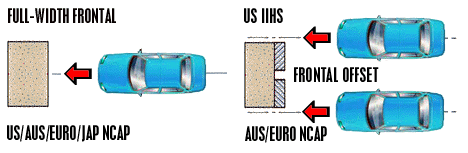
Insurance Institute for Highway Safety (IIHS), recognizing
the limitations of the full-frontal crash test used by NHTSA,
uses a frontal offset crash test similar to tests used by the
Australian and European New Car Assessment Programs (Euro-NCAP
and ANCAP). Offset tests
challenge a vehicle's structure more than full-frontal tests do,
providing more information on passenger safety in the most common
kinds of collisions.
The IIHS
begain using its 40% offset, 40 mph test in 1995, ranking results
into four categories based on the amount of protection from serious
injury.
|
|
Rating Categories
 |
Good protection
from serious injury |
 |
Acceptable
protection from serious injury |
 |
Marginal
protection from serious injury |
 |
Poor
protection from serious injury |
In the Institute's 40 mph
offset test, 40 percent of the total width of each vehicle strikes
a barrier on the driver side. The barrier's deformable face is
made of aluminum honeycomb, which makes the forces in the test
similar to those involved in a frontal offset crash between two
vehicles of the same weight, each going just less than 40 mph.
This means test results can be compared only among vehicles of
similar weight. Like full-width crash test results, the results
of offset tests cannot be used to compare vehicle performance
across weight classes.
For more information on offset
crash tests please read the following research paper written by
Australian safety expert Michael Paine:
"Offset Crash Tests"
Head Restraints -
Headrests
are supposed to provide protection against whiplash in rear-end
collisions. In reality most headrests provide little to no protection.
European automobiles rate far better than domestic or Asian models
in this area (see the IIHS
Website for
head restraint ratings for vehicles sold in the US).
The US DOT required their installation in 1967, but haven't
provided updated modern standards for their successful implementation.
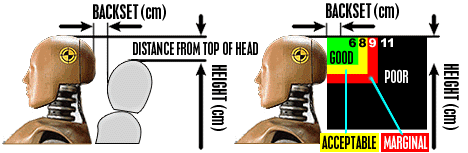
An effective headrest is directly behind the centerline of the
head and positioned no more than a couple of inches away.
|
|
Rating Categories
|
Good protection
from serious injury |
|
Acceptable
protection from serious injury |
|
Marginal
protection from serious injury |
|
Poor
protection from serious injury |
The IIHS
determines whether the front-seat head restraints can be positioned
behind and close enough to the back of the head to limit relative
head and torso movement (whiplash) in rear-end collisions. A
restraint needs to be as high as the head's center of gravity,
or 7 cm (3 inches) from the top of the head. The distance from
the head restraint to the back of the head should be less than
7 cm (3 inches) as well. Backsets
of more than 10 centimeters (4 inches) have been associated
with increased symptoms of neck injury in crashes.
Certain models offer
different seating options so doublecheck the IIHS
ratings if you have optional seating.
The IIHS
website provides a comprehensive list
of head restraint ratings for North American vehicles.
Since over 70% of the vehicles they tested got failing marks,
we have decided NOT to include
the ratings in our results. However a link is provided
on each page that will take you to the IIHS
head restraint ratings for each manufacturer (click on the manufacturer's
name under the ratings key). Suffice it to say, an overwhelming
majority of the highest rated head restraint systems were only
available on vehicles manufactured in Europe. IIHS
ratings are good predictors of how well people will be protected
in rear-end crashes - drivers of vehicles with top-rated restraints
are less likely to suffer neck injuries than those with poorly
rated restraints.
For more
information about head restraints see the following 1996 NHTSA
report "Identification
of Issues Relevant to Regulation, Design, and Effectiveness
of Head Restraints"
|
 |
 |
|
| |
 |
|
轿车工业
越来越多的中国人拥有汽车或汽车梦,这个潜在的庞大市场吸引海内外汽车制造商的进入,加入世界贸易组织(WTO)意味着中国市场面向世界开放。 |
| |
|
|
|
| |
|
|
客车世界
高速公路网的建设以及城市公共交通服务水平的改善,中国巴士和客车的需求正不断地增长,《客车世界》资料的有偿服务将为你工作提供帮助。 |
| |
|
|
|
| |
|
|
卡车天地
商用卡车一直在中国运输产业中起着重要作用,如何从质量、油耗、寿命和故障等方面考虑选择使用卡车却是一个新课题。 |
| |
|
|
|
| |
|
|
摩托车界
中国是自行车的王国,也是全球最大的摩托车制造商。当自行车逐渐被摩托车所取代后,电动自行车的市场前景究竟有多大? |
| |
|
|
|
|